English
  中文简体
中文简体  Español
How to Choose Steam Switch for Household Electric Kettles
The kettle boils dry. Or it fails to cut off when it should, leaving water at a rolling boil long after it is ready. Maybe the switch trips too early — the kettle clicks off before the water has fully reached temperature, and whoever made the tea has to reheat it. These are not random appliance quirks. They trace back to the Kettle Steam Switch — the component responsible for detecting steam pressure at boiling point and triggering the automatic shut-off. When it works correctly, nobody notices it. When it fails or degrades, the failure shows up in ways that affect safety, energy use, and user experience simultaneously.
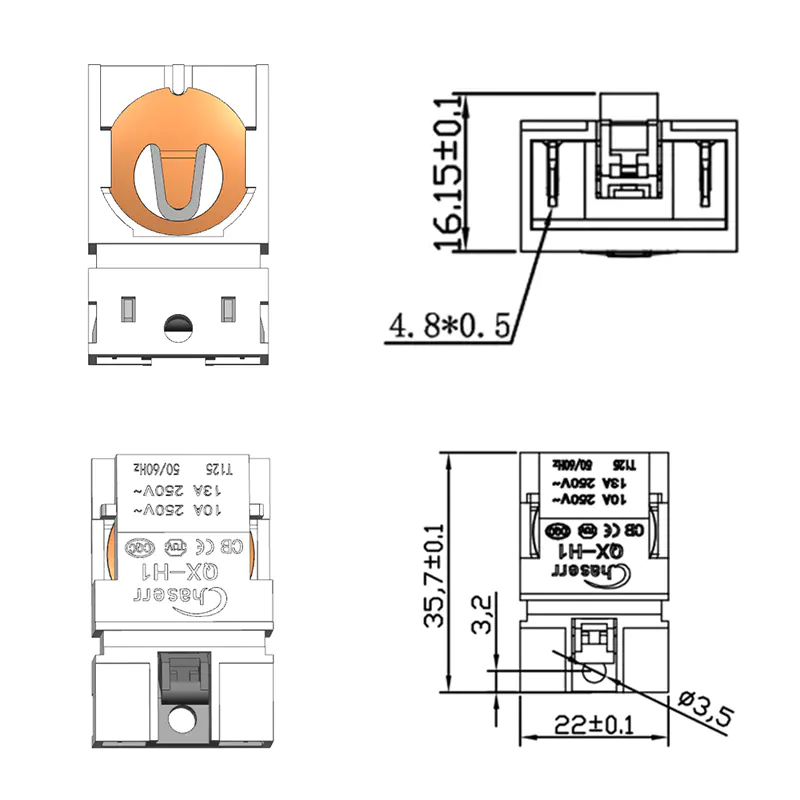
For appliance repair technicians, small appliance manufacturers, and component procurement teams sourcing replacement parts, choosing the right steam switch for a household kettle is a technical decision with real downstream consequences. A switch that is undersized for the kettle's power rating, poorly matched to the steam channel geometry, or built to a lower durability standard than the application demands will underperform consistently — and in a safety-critical component, underperformance is not an acceptable outcome.
What a Kettle Steam Switch Actually Does
How Does the Auto Shut-Off Mechanism Work?
The steam switch sits in the steam channel of the kettle — a narrow passage that routes steam from the interior of the kettle body toward the handle or base unit where the control mechanism lives. When water reaches boiling point, steam travels through this channel under pressure. The switch detects that steam — either through direct thermal contact or through a bimetallic element that responds to temperature — and trips the circuit, cutting power to the heating element.
The accuracy and speed of this response depend on the switch's sensitivity to steam temperature and its mechanical design. A well-calibrated switch trips consistently at a temperature that corresponds reliably with boiling, regardless of ambient temperature variation, scale buildup on the heating element, or small differences in fill level between uses.
A poorly calibrated or degraded switch introduces variation. It might trip at slightly different points from one use to the next. Over time, contact degradation or bimetallic element fatigue causes the response to drift — the switch trips too late, too early, or not at all.
The Main Switch Types Used in Household Kettles
Which Mechanism Types Are Available, and How Do They Differ?
The Kettle Steam Switch category covers several mechanical approaches, each with different performance characteristics and failure modes.
Bimetallic Strip Switches
The bimetallic strip is a common mechanism in household kettle switches. Two metals with different thermal expansion rates are bonded together. When heated by steam, the strip bends — because one metal expands more than the other — until the deflection is sufficient to trip the contact and break the circuit.
Characteristics of bimetallic switches:
- Reliable in well-designed implementations; the mechanism is mechanically simple.
- Response speed depends on the thermal mass of the strip and its proximity to the steam flow.
- Over many operating cycles, the strip can fatigue, causing response drift — the trip point shifts over time.
- Sensitivity can be affected by limescale or moisture condensation on the strip surface.
Mechanical Steam Pressure Switches
Some switch designs use the pressure of the steam flow itself — rather than temperature — to actuate a mechanical contact. The steam presses against a diaphragm or lever mechanism, triggering the trip when pressure crosses a threshold.
- Less susceptible to ambient temperature effects than purely thermal designs.
- Can be more sensitive to variations in steam channel geometry and scale buildup that restrict flow.
- The mechanical components in the pressure path are subject to wear over many cycles.
Thermal Cutout with Steam Channel Integration
Some kettle designs integrate a thermal cutout that is positioned in the steam path and responds to the temperature of steam contact directly. These are simpler in mechanical terms but rely heavily on consistent steam channel routing for accurate response.
The switch type used in a given kettle is determined by the original manufacturer's design. Replacement parts need to match not just the electrical specifications but the mechanical interface and the detection mechanism to work correctly.
Why Durability Matters More Than Initial Sensitivity
What Causes Steam Switches to Fail Over Time?
A switch that responds accurately on day one but degrades after a year of daily use is not a reliable component. Understanding the failure modes helps both in selecting a replacement and in evaluating switch quality during procurement.
Contact Wear and Arcing
Every time the switch trips, electrical current is interrupted across the contact pair. At the voltage and current levels of a household kettle heating element, this interruption produces a small arc. Over many thousands of cycles, arcing erodes the contact surface. As contacts degrade, resistance across the circuit increases when closed, and the arc on opening becomes larger, accelerating further erosion. The visible symptom is a switch that eventually fails to make reliable contact — the kettle cuts out intermittently, or stops switching off cleanly.
Bimetallic Fatigue
The repeated thermal cycling of a bimetallic strip — heating during boiling, cooling between uses — gradually changes the strip's mechanical properties. The deflection curve shifts. A strip that originally tripped at exactly the right temperature may, after extended use, trip at a slightly different point. In mild cases this is an inconvenience. In cases where the drift is significant enough to allow sustained overboiling or prevent shut-off entirely, it becomes a safety issue.
Limescale and contamination
In hard water areas, limescale deposits form inside the kettle and can migrate into the steam channel. Scale on the bimetallic strip insulates it from steam contact, slowing thermal response. Scale in a pressure-based switch mechanism can restrict movement. Either effect degrades switch response. Some switch designs are more tolerant of scale buildup than others — an important consideration for kettles sold in hard water regions.
Condensation and Corrosion
Moisture condensing on switch contacts or bimetallic elements between uses can promote oxidation. Oxidized contacts have higher resistance and may not make clean electrical contact. Oxidation on a bimetallic strip affects its thermal response characteristics.
Key Selection Criteria When Replacing or Sourcing a Switch
Choosing a replacement Kettle Steam Switch requires matching several specifications simultaneously — not just the electrical rating.
| Selection Factor | Why It Matters | What to Check |
|---|---|---|
| Voltage and current rating | Undersized contacts arc and fail faster | Match the kettle's rated wattage and supply voltage |
| Mechanical interface | Mismatched geometry causes poor steam exposure | Confirm channel dimensions and mounting format |
| Trip temperature range | Incorrect calibration causes early or late shut-off | Verify calibration against the kettle's boiling point spec |
| Cycle durability rating | Low-rated switches fail prematurely in daily-use kettles | Request cycle count specifications from the supplier |
| Contact material | Affects arc resistance and long-term reliability | Silver alloy contacts generally outlast base metal alternatives |
| Scale tolerance | Critical in hard water markets | Look for enclosed or sealed designs where possible |
| Reset behavior | Some switches require manual reset; others auto-reset | Match to the original design's user experience requirement |
Running through this checklist before committing to a replacement or a bulk sourcing order prevents common compatibility and durability failures.
Matching the Switch to the Kettle's Power Profile
Does a High-Wattage Kettle Need a Different Switch Than a Low-Wattage One?
Yes, and this is a dimension of switch selection that gets overlooked in replacement decisions.
A higher-wattage kettle heats water faster, which means the heating element is drawing more current, and when the switch trips, it is interrupting a larger electrical load. The arc at contact separation is proportionally larger. A switch contact pair rated for a lower-current application will experience accelerated erosion when used in a higher-wattage kettle.
Additionally, a higher-wattage kettle generates steam volume more rapidly. The steam pressure in the channel rises faster. A switch calibrated for a lower steam flow rate may trip slightly earlier in a high-wattage kettle than it was designed to — the steam reaches the detection element faster than the original calibration assumed.
Practical implications for sourcing:
- Always match the switch's current rating to the kettle's rated current draw, not just its voltage.
- For high-wattage professional or semi-commercial kettles, look for switches rated at the upper end of the household appliance range.
- In markets where both high and low wattage models are sold, avoid mixing switch specifications across product lines even if the physical interface appears similar.
Compatibility Across Kettle Designs
Can a Single Switch Model Work Across Multiple Kettle Types?
In practice, no single switch design covers all kettle configurations — though some switch models cover a range of compatible kettles within a specific mounting format.
The factors that determine cross-model compatibility:
- Steam channel diameter and routing. The switch must sit in the steam flow path correctly to detect steam. A switch designed for a wide-channel kettle will not perform accurately in a narrow-channel design even if the electrical interface is identical.
- Mounting orientation. Some switches are designed for vertical mounting; others for horizontal or angled installation. Orientation affects how steam contacts the detection element and how condensate drains away from the switch body.
- Handle vs. base unit integration. Cordless kettles with 360-degree base connections route steam through the handle to a switch in the handle body. Corded kettles may route steam differently. The switch position in the assembly affects what specification is needed.
- Auto-reset vs. manual-reset design. Most consumer kettles use auto-reset switches that allow immediate re-boiling. Some designs use manual-reset switches. These are not interchangeable in the same assembly without also changing the user experience and potentially the safety behavior of the product.
For procurement teams sourcing switches for a range of kettle models, building a compatibility matrix — mapping each kettle model to the specific switch specification it requires — reduces the risk of incorrect substitutions during production or repair supply.
How to Evaluate Switch Quality Before Committing to Volume
What Should Procurement Teams Look for Beyond the Specification Sheet?
A specification sheet confirms what a switch is rated for under controlled conditions. It does not guarantee that production units consistently meet those ratings across a batch. For components used in safety-critical applications — and the auto shut-off mechanism of an electric kettle is a safety-critical function — batch consistency matters as much as the specification itself.
Evaluation steps before committing to a volume order:
- Request sample units and test them across the full operating range — not just at nominal conditions.
- Run accelerated cycle testing if possible: repeated boil-and-trip cycles to identify early failure patterns.
- Inspect contact surface quality on sample units. Uneven or oxidized contact surfaces on new parts indicate quality control issues.
- Check the bimetallic strip for uniform dimensions and consistent spring force across multiple samples.
- Confirm that the supplier can provide lot traceability documentation — important for recall management if a batch issue is identified after distribution.
- Verify that the electrical ratings are certified by a recognized testing authority for the target market, not just self-declared.
For OEM manufacturers building new kettle models, involving the switch supplier in the design process — confirming that the steam channel geometry, power rating, and assembly orientation are matched to available switch specifications — is more effective than selecting a switch after the kettle design is finalized.
Common Failure Scenarios and What They Indicate
How Do You Diagnose a Steam Switch Problem Versus Another Kettle Fault?
Steam switch failure is one of several possible causes of kettle malfunction, and misdiagnosis wastes time and parts. Understanding which symptom points to the switch specifically helps narrow the diagnosis.
- Kettle does not shut off automatically. The switch is not tripping when steam reaches it. Possible causes: degraded bimetallic strip, scale insulating the detection element, contact failure keeping the circuit closed, or a blocked steam channel preventing steam from reaching the switch.
- Kettle shuts off before water fully boils. The switch is tripping too early. Possible causes: bimetallic fatigue shifting the trip point lower, steam channel geometry causing premature steam detection (steam condensing and collecting before reaching boiling temperature), or a replacement switch calibrated for a different temperature range.
- Kettle shuts off intermittently. Contact wear causing unreliable make/break, or a bimetallic strip with inconsistent response due to fatigue or contamination.
- Kettle does not turn on after sitting idle. Some switch designs can stick in the tripped position, particularly if moisture has condensed and then dried on the bimetallic strip. Manual reset resolves this in auto-reset designs; if it recurs consistently, the switch should be replaced.
Matching the symptom to the failure mode guides replacement specification — replacing with an identical part resolves like-for-like wear; replacing with an upgraded specification addresses a design limitation in the original component.
Selecting the right Kettle Steam Switch is not simply a matter of finding a part that fits the mounting hole. The switch is the safety mechanism that prevents boil-dry events, protects against overheating, and maintains the user experience that consumers expect from a well-functioning kettle. Getting the specification right — matching current rating, channel geometry, calibration range, and durability class to the specific kettle design — determines whether the replacement or sourced component performs reliably across the product's service life. For repair technicians working across multiple kettle brands, procurement teams building replacement parts inventory, or manufacturers evaluating switch components for new product development, working with a supplier who can provide specification documentation, sample testing support, and consistent production quality makes the selection process substantially more straightforward. Wenzhou Qianxun Electrical Technology Co., Ltd. manufactures a range of Kettle Steam Switches for household appliance applications, with specifications covering a broad range of power ratings and mounting configurations — contact the team to discuss your requirements or request samples for evaluation.
Featured Products


-
No. 2892, Ningkang East Road, Tiancheng Industrial Zone, Yueqing City, Zhejiang Province
-
 Email: Una@chaserr.cc
 -
 Phone: +86-13075775533
- GET IN TOUCH

Electric Kettle Thermostat Coupler Manufacturer