English
  中文简体
中文简体  Español
Comparing Steam Switch and Bimetal Thermostat Functions
Designing a reliable electric kettle takes more component decisions than many outside the industry realize. The heating element gets attention. The body material gets attention. But the cut-off mechanism, the part that actually stops the appliance from overheating or running dry, often gets treated as an afterthought until something goes wrong. A Kettle Steam Switch and a bimetal thermostat are both thermal control solutions, but they operate on entirely different principles, fail in different ways, and suit different product requirements. For engineers and procurement teams working through appliance design or supplier selection, understanding the distinction in practical terms is worth the time.
How Does a Steam Switch Actually Work?
The Operating Principle Behind Steam-Triggered Cut-Off
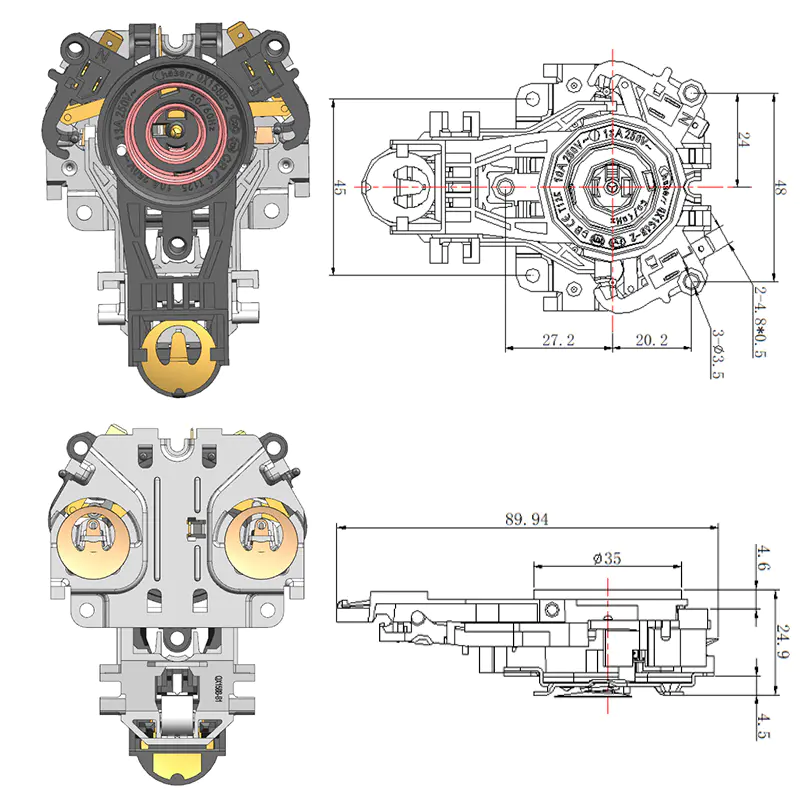
A steam switch does not measure temperature directly. Instead, it responds to the steam produced when water reaches boiling point. As the kettle heats, steam travels up through a dedicated channel toward the switch housing. That steam contacts a bimetal disc inside the switch mechanism, causing it to snap from one position to another. The snap movement breaks the electrical circuit and cuts power to the heating element.
The key detail here is that the trigger is steam pressure and temperature combined, not ambient heat or surface temperature. The switch responds to the boiling event itself rather than to a preset temperature threshold. That distinction matters for response speed and for how reliably the cut-off correlates with actual boiling rather than a temperature approximation.
Why Does the Steam Channel Design Matter?
The path that steam travels from the water chamber to the switch affects how consistently the mechanism triggers. A well-designed channel delivers steam to the bimetal disc promptly and cleanly. A poorly designed one may allow condensation to accumulate, introduce delays, or in some cases cause the switch to trigger prematurely if steam builds up in unexpected ways.
For manufacturers, this means the switch design and the kettle body design are not fully independent variables. The steam channel geometry, the switch mounting position, and the internal airflow all interact. Sourcing a switch without considering how it integrates with the specific kettle body is one of the more common sources of inconsistent cut-off behavior in production units.
How Does a Bimetal Thermostat Work?
Temperature-Driven Mechanical Deformation
A bimetal thermostat takes a different approach entirely. It consists of two metal strips bonded together, each with a different thermal expansion rate. When the assembly heats up, the two metals expand at different rates, which causes the combined strip to bend. At a preset temperature, that bending reaches a point where it triggers an electrical contact, cutting the circuit.
The mechanism is purely temperature-driven. It does not care whether the heat comes from steam, radiant heat, or direct contact with a hot surface. It responds to the thermal state of the strip itself, which reflects the surrounding temperature in whatever housing or appliance it sits inside.
Where Is a Bimetal Thermostat Typically Used?
The bimetal thermostat is found across a wide range of thermal appliances precisely because its response mechanism generalizes well. It does not require steam, so it works in products where no steam is produced. Ovens, hair dryers, irons, toasters, and various motor-driven appliances all use bimetal thermostats because the control logic is straightforward and the mechanism is robust across many different thermal environments.
In electric kettles specifically, bimetal thermostats appear in some designs, particularly as a secondary safety layer or in dry-boil protection systems. But they are not the standard cut-off mechanism for kettles in many markets, and the reason for that comes down to response characteristics.
Response Speed: Which Mechanism Acts Faster?
Steam Switches React to the Boiling Event Directly
When water boils in a kettle, steam generation happens rapidly. A steam switch positioned correctly in the steam channel responds to that event within a short window, cutting power as boiling begins rather than waiting for heat to conduct through materials and raise a thermostat to its trigger point.
This matters for a few reasons. Energy is not wasted continuing to heat water that has already boiled. The heating element is not subjected to unnecessary additional thermal stress. And from a user experience perspective, the kettle shuts off promptly, which reinforces the perception of reliable, precise operation.
Does a Bimetal Thermostat React More Slowly?
In a kettle application, yes, generally. A bimetal thermostat mounted on or near the heating element responds to element temperature rather than to the boiling event itself. Heat needs to conduct from the water through the element and into the thermostat housing before the bimetal strip reaches its trigger point. That pathway introduces a delay.
Under normal operating conditions, that delay may be small enough to be unnoticeable. But in edge cases, such as a kettle with a partial water fill or one operating in an environment with unusual ambient temperature, the delay can mean the heating element continues running longer than necessary. Over many cycles, that affects both energy consumption and component wear.
Safety Comparison: Which Is More Reliable in a Kettle Context?
Steam Switches Handle the Most Common Risk Scenario Well
The scenario that matters for kettle safety is automatic cut-off when boiling is complete, preventing the element from running dry or overheating the body. A steam switch is specifically designed around that scenario. Its trigger is the boiling event, which is exactly the condition that requires intervention.
In the context of a standard filled kettle, this alignment between trigger condition and safety requirement makes the steam switch a reliable solution. It cuts power when the water boils, which is when it should.
What Happens When a Steam Switch Fails?
Failure modes are worth understanding. A steam switch can fail in two directions: it either cuts off too early, interrupting the heating cycle before water has fully boiled, or it fails to cut off at all, leaving the element running.
Common causes of premature cut-off:
- Condensation in the steam channel creating false steam signals
- Bimetal disc fatigue from repeated thermal cycling
- Incorrect switch positioning during assembly
Common causes of failure to cut off:
- Steam channel blockage preventing steam from reaching the switch
- Bimetal disc losing its snap response after extended use
- Contamination inside the switch housing affecting mechanical movement
A secondary thermal fuse is standard in well-designed kettles precisely because primary steam switch failure, while uncommon in quality components, is not impossible.
Are Bimetal Thermostats Safer in Other Appliance Types?
For appliances where steam is not the relevant thermal signal, yes. An iron running too hot, a motor overheating, a heating element in an oven approaching a dangerous temperature, these scenarios are not steam-generating events. A bimetal thermostat responds to the actual temperature condition that represents the risk, which makes it the appropriate mechanism for those applications.
The safety comparison between steam switch and bimetal thermostat is really a comparison of fit to application. Neither is categorically safer in the abstract. Each is safer when matched to the appliance type it was designed for.
Durability and Long-Term Performance
How Does Repeated Cycling Affect Each Mechanism?
Both mechanisms involve a bimetal element, but they experience different stress profiles in use. A Kettle Steam Switch cycles repeatedly through the same snap-action motion: the bimetal disc deflects sharply under steam heat and resets as it cools. The mechanical stress in each cycle is concentrated in that snap event.
High-quality steam switch components are engineered for a defined cycle life. Disc fatigue is the primary wear mechanism. As the disc loses some of its snap characteristics over time, the trigger temperature may shift slightly or the response may become less crisp.
A bimetal thermostat in a kettle application experiences slower, more gradual bending rather than the sharp snap action of a disc. In some respects, this is gentler on the metal. But thermostat-based cut-off in a kettle is less common for the response speed reasons discussed above, so long-term kettle durability comparisons between the two types are somewhat context-dependent.
What Environmental Conditions Affect Performance?
Steam switches operate in a high-humidity environment by design. Moisture tolerance is part of what a quality kettle switch component needs to handle. Degradation in humid conditions is not a major concern for switches designed specifically for kettle applications.
Bimetal thermostats used in lower-humidity appliances may be less optimized for moisture exposure. Using a general-purpose bimetal thermostat in a steam-rich environment can accelerate corrosion on contact surfaces or introduce contamination into the mechanism over time.
Side-by-Side Comparison for Appliance Designers
Engineers and procurement teams evaluating these two control mechanisms for specific applications will find the decision hinges on a clear set of variables rather than a blanket preference for one technology.
| Comparison Factor | Kettle Steam Switch | Bimetal Thermostat |
|---|---|---|
| Trigger mechanism | Steam pressure and temperature | Temperature-induced metal bending |
| Response to boiling | Direct and prompt | Indirect via heat conduction |
| Typical kettle application | Primary cut-off mechanism | Secondary protection or dry-boil backup |
| Suitable appliance types | Electric kettles | Ovens, irons, motors, diverse heating appliances |
| Humidity tolerance | Designed for steam environment | Varies by product specification |
| Failure mode: early cut-off | Condensation or disc fatigue | Calibration drift |
| Failure mode: no cut-off | Channel blockage or disc wear | Contact contamination |
| Manufacturing integration | Requires steam channel design | More flexible mounting options |
| Cost in mass production | Competitive for kettle volumes | Competitive across broader appliance types |
Manufacturing Cost and Mass Production Considerations
Does the Choice of Mechanism Affect Production Cost?
At volume, both mechanisms can be sourced competitively. The cost comparison depends less on the component itself and more on the integration requirements.
A steam switch requires a properly designed steam channel in the kettle body. That channel adds a design constraint but is standard in electric kettle manufacturing. The switch itself is a relatively simple component when sourced from a supplier with kettle-specific experience.
A bimetal thermostat used in a kettle application may require additional calibration or positioning to ensure accurate trigger temperature. If used as a primary cut-off rather than a secondary safety element, the placement and mounting need to ensure the thermostat reflects the relevant thermal condition accurately.
For a manufacturer producing electric kettles at scale, the steam switch approach is well-established and the supply chain around it is mature. Switching to a thermostat-based primary cut-off would require design validation and may not offer clear cost advantages that justify the engineering effort.
What Do Safety Certifications Require?
Most markets require electric kettles to meet appliance safety standards that address automatic cut-off under boiling and dry-boil conditions. Steam switches designed for kettle applications are typically developed and tested against these requirements as part of the component specification.
When sourcing cut-off components, buyers should confirm that the supplier can provide documentation supporting the certification requirements relevant to their target markets. This is particularly important for export-oriented manufacturers whose products need to meet multiple regional standards simultaneously.
Applying This to Product Design Decisions
Which Control Mechanism Suits a New Kettle Design?
For a standard electric kettle, the steam switch is the conventional and well-validated approach. It aligns with how the product operates, responds to the correct trigger condition, and has an established supply chain behind it.
For a kettle with additional safety requirements, such as one designed for markets with strict dry-boil protection standards, a combination approach is common: a steam switch as the primary cut-off and a bimetal thermal fuse as a backup that activates if the primary mechanism fails. This layered approach covers both the normal boiling event and the abnormal scenario of the primary switch not cutting off.
For non-kettle appliances, the bimetal thermostat is generally the more appropriate solution, and the design should specify the trigger temperature and mounting conditions to ensure reliable performance in the target application.
Choosing the Right Component Supplier
The component itself accounts for only part of the outcome. Consistency across production batches, documentation for certification purposes, and responsive technical support during product development all affect how smoothly a new appliance design moves from prototype to production. Wenzhou Qianxun Electrical Technology Co., Ltd. manufactures Kettle Steam Switches and related thermal control components for electric appliance applications. For design engineers working through component selection, or procurement teams evaluating suppliers for a new kettle product line, their technical team can discuss component specifications, certification documentation, and integration requirements based on the specific appliance design. If you are at the stage of finalizing a control mechanism for a kettle or small appliance product, reaching out with your design parameters is a practical way to move the evaluation forward with supplier-level input rather than general guidance.
Featured Products


-
No. 2892, Ningkang East Road, Tiancheng Industrial Zone, Yueqing City, Zhejiang Province
-
 Email: Una@chaserr.cc
 -
 Phone: +86-13075775533
- GET IN TOUCH

Electric Kettle Thermostat Coupler Manufacturer