English
  中文简体
中文简体  Español
How Can a Kettle Base Connector Improve Component Compatibility
Electric kettles look pretty basic from the outside, but everything supporting them underneath has to work together in a fairly tight, coordinated way. Kettle body, power base, connection points, control elements, temperature-related parts — all of it feeds into what the user actually experiences when they flip the switch.
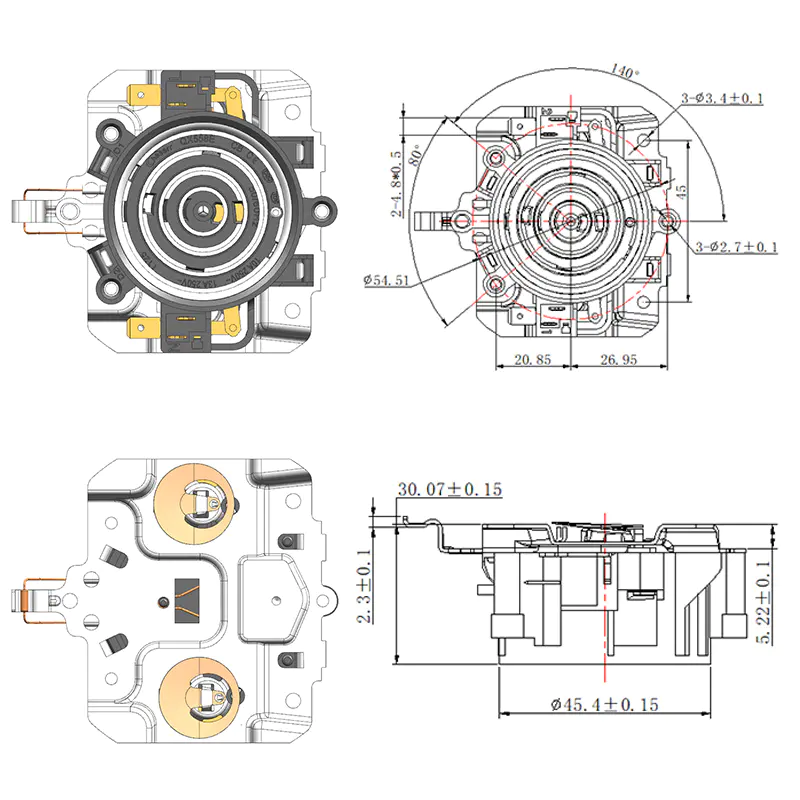
A small connection piece ends up carrying a lot of that relationship on its shoulders. An Electric Kettle Base Coupler links the kettle body with its base and the electrical components sitting behind it. Its design shapes how easily different parts actually fit together, and how consistently the whole product keeps working through repeated daily use.
As kettle designs keep evolving, manufacturers run into a pretty practical problem. They need new shapes and functions rolling out constantly, but the relationships between components still have to stay manageable underneath all that variety. Compatibility, then, really belongs in the design process from day one, not treated as some afterthought that only surfaces once assembly starts.
Why Does Component Compatibility Matter in Electric Kettle Design?
Compatibility, at its core, comes down to how well separate parts actually work together inside one product structure. For an electric kettle, that covers physical fit, electrical connection, positioning, and how the operating components interact with each other once everything's assembled.
A kettle body might have its own particular base structure, while the power base needs to offer up a connection that actually matches it. Get that mismatch wrong, and assembly turns into a headache, plus the whole user experience can end up feeling off too.
Component compatibility touches several areas at once:
| Compatibility Area | Design Consideration |
|---|---|
| Physical connection | Parts need to fit together properly |
| Electrical contact | Connection points need suitable positioning |
| Base alignment | Kettle and base should sit naturally together |
| Control interaction | Related components need coordinated placement |
| Maintenance | Parts should be practical to inspect or replace |
That's exactly why a small coupler shouldn't get treated like some isolated little part sitting off on its own. Its design has to account for whatever's around it, and for the kettle's structure as a whole.
How Does a Base Coupler Connect Different Kettle Components?
A Kettle Base Connector works as part of the relationship linking the kettle to whatever base it's sitting on. Its structure helps build a stable interface while still letting the kettle get lifted off and placed back down without a fight.
That connection needs to hold up naturally through everyday use, too. Someone lifts the kettle, sets it back on the base, maybe rotates it slightly or repositions it a few times over the course of making tea for a group of people. The coupling structure needs to support that kind of connection and movement at the same time, not one or the other.
A workable design tends to weigh:
- Contact position.
- Component alignment.
- Ease of placement.
- Stability after connection.
- Relationship with surrounding housing.
- Compatibility with control components.
This gets more involved once different kettle models start using different body shapes or base arrangements. The Base Coupler has to fit whatever structure it's paired with, without forcing unnecessary changes everywhere else in the product.
Can One Coupler Design Support Different Electric Kettle Models?
Different kettle models vary in appearance, capacity, handle position, base structure, control layout — the list goes on. Those differences make compatibility genuinely tricky if every single product needs its own completely separate internal setup.
Standardized connection concepts help cut down on that complexity quite a bit.
An Electric Kettle Base Coupler can get built around one shared connection principle, while everything around it flexes according to whatever the specific product calls for.
That approach lands somewhere between full standardization and full customization, which turns out to be a pretty useful middle ground.
The basic connection structure, for instance, might stay consistent even as outer housing, control layout, or the kettle body itself changes from model to model.
| Product Variation | Possible Design Response |
|---|---|
| Different kettle shapes | Adapt surrounding housing |
| Different base structures | Adjust connection arrangement |
| Different control layouts | Coordinate component placement |
| Different handle positions | Keep the connection area independent |
| Different product appearances | Preserve the internal connection concept |
The goal isn't forcing every kettle into some rigid single mold. It's building a connection approach flexible enough to work across a whole family of related product structures.
How Does the Coupler Work With Temperature Control Components?
Temperature control sits at the heart of modern kettle design. The control component has to interact with the heating system while staying properly positioned within everything else packed into the kettle.
The base connection shapes how all of that fits together. Let the coupler eat up too much space, or force some unusual layout, and other components end up having to shift around to make room.
That's exactly where design coordination earns its keep.
The coupler, heating-related parts, and control elements really need thinking through together, rather than getting designed off in separate silos.
A layout that's actually been planned well tends to deliver:
- Clear component positioning.
- Practical connection paths.
- Easier assembly.
- Better use of internal space.
- More consistent relationships between related parts.
The goal here isn't just shrinking the coupler down as small as possible, either. A compact part isn't automatically the right call if it just creates headaches for whatever else has to sit nearby.
The whole design around it needs to stay in balance.
Why Is Parts Standardization Useful for Manufacturers?
Standardization simplifies production nicely once several products share similar component needs. Instead of building a brand new connection system from scratch for every single kettle, manufacturers can lean on related components across a whole product range.
That cuts down a lot of unnecessary variation.
It also makes purchasing and inventory a lot less of a headache, since fewer distinct component types need tracking and stocking.
Standardization tends to support:
- Simplified component sourcing.
- More consistent assembly procedures.
- Easier inventory organization.
- More manageable replacement parts.
- Greater flexibility during product development.
That said, standardization shouldn't block product improvement, either. Different kettle models still need room to change and evolve. A sensible approach standardizes whatever genuinely doesn't need to change, while leaving enough room for product-specific tweaks elsewhere.
That balance keeps manufacturers from swinging too far into either excessive customization or a design that's locked too rigidly in place.
How Can Design Optimization Improve Base Compatibility?
Design optimization often begins with understanding how components interact with each other.
A kettle base often packs several parts into a pretty tight space. Redesign one part without thinking about the others, and the result can be a nightmare to assemble, or an internal layout that just wastes room.
The coupler, then, deserves consideration right from early product development.
Design teams can look at where the connection area sits, the shape of whatever's nearby, and exactly how the kettle body meets up with the base.
They can also think through how the component's going to hold up during assembly and through the wear and tear of everyday use.
| Design Focus | Potential Benefit |
|---|---|
| Connection position | Supports better component alignment |
| Space arrangement | Makes room for related parts |
| Part shape | Supports easier assembly |
| Interface design | Helps maintain compatibility |
| Modular structure | Allows selected components to change |
The whole process is less about piling on complexity and more about clearing away unnecessary friction between parts.
An interface that's been thought through carefully can make developing the whole product a lot smoother.
How Does Compatibility Affect Assembly and Maintenance?
A component that actually fits well simplifies the relationship between whatever's being assembled around it.
Once the connection points are clearly defined, workers can place components a lot more consistently. That cuts down the constant back-and-forth adjustments that otherwise creep into production.
Maintenance benefits from practical component relationships too. Keep a connection area accessible and logically laid out, and inspection or replacement gets a lot easier down the line.
Design needs to account for both manufacturing and whatever servicing comes later.
For manufacturers, that might mean thinking through how the coupler gets positioned during assembly. For maintenance crews, it might mean making sure related parts can actually be reached without tearing the whole thing apart.
A useful design approach really considers the full product life cycle:
- Component sourcing.
- Assembly.
- Product testing.
- Daily use.
- Inspection.
- Maintenance.
- Replacement.
Compatibility becomes a lot more valuable once it actually supports several of these stages, rather than just patching over one assembly problem and calling it done.
What Challenges Can Occur When Components Are Not Properly Matched?
Poor compatibility tends to surface trouble at all sorts of different stages during product development.
A physical mismatch makes assembly a struggle. A poorly placed connection point throws off where nearby components can actually sit. Change one part, and suddenly several others need redesigning too, whether anyone planned for that or not.
Issues like these pile up development work fast and make production a lot more complicated than it needs to be.
The root cause usually does not come from a single component acting on its own. It often depends on how multiple parts interact with each other within the system.
Change the kettle body, for instance, and that can ripple straight into the base interface. That shift then touches the control component's position, the housing structure, and the whole assembly process right along with it.
That's exactly why planning the interface early actually matters.
How Can Modular Design Support Different Kettle Product Lines?
Modular design lets certain components stay consistent while everything else around them changes freely.
That's genuinely useful for manufacturers building several kettle models with different looks or different user functions.
The base connection can form part of a shared module here. Product-specific components then get arranged around that shared interface, rather than everything getting rebuilt from scratch each time.
That kind of approach helps build out a whole product family without redesigning every single component over and over.
The modular concept also leaves room for future adjustments down the line. Change the outer look while the underlying connection needs stay roughly similar, and that existing component relationship can often carry over just fine.
That flexibility makes ongoing development a lot easier to manage.
The real trick is figuring out which parts genuinely need to stay common across the board, and which ones deserve adapting for each individual model.
How Does Component Compatibility Influence Product Development?
Product development gets a lot more manageable once component relationships get treated as one connected system, rather than a pile of separate parts.
An Electric Kettle Base Coupler might be physically tiny, but where it sits affects the kettle body, the base, control components, the assembly process, and even how easy the thing is to maintain down the road.
A connection design that's genuinely been thought through leaves room for product variation without forcing every single model into some completely different internal arrangement.
The same idea applies to standardization. Shared components simplify production, sure, but they still need to leave designers enough room to respond when different products call for something different.
As electric kettle designs keep moving forward, compatibility keeps getting tangled up more and more with modular construction, coordinated component placement, and manufacturing methods that actually hold up in practice.
The whole focus is shifting away from designing individual parts in isolation, and toward building relationships that let the kettle body, base, temperature control components, and connection elements all work together as one coordinated product structure.
Featured Products


-
No. 2892, Ningkang East Road, Tiancheng Industrial Zone, Yueqing City, Zhejiang Province
-
 Email: Una@chaserr.cc
 -
 Phone: +86-13075775533
- GET IN TOUCH

Electric Kettle Thermostat Coupler Manufacturer