English
  中文简体
中文简体  Español
Hard Water Conditions Influence Thermostat Sensitivity and Durability?
Does Hard Water Affect Sensor Precision?
The Anti-Drying Kettle Thermostat is designed to detect temperature changes quickly and prevent dangerous dry-boil conditions, but hard water environments can introduce challenges to its sensitivity.
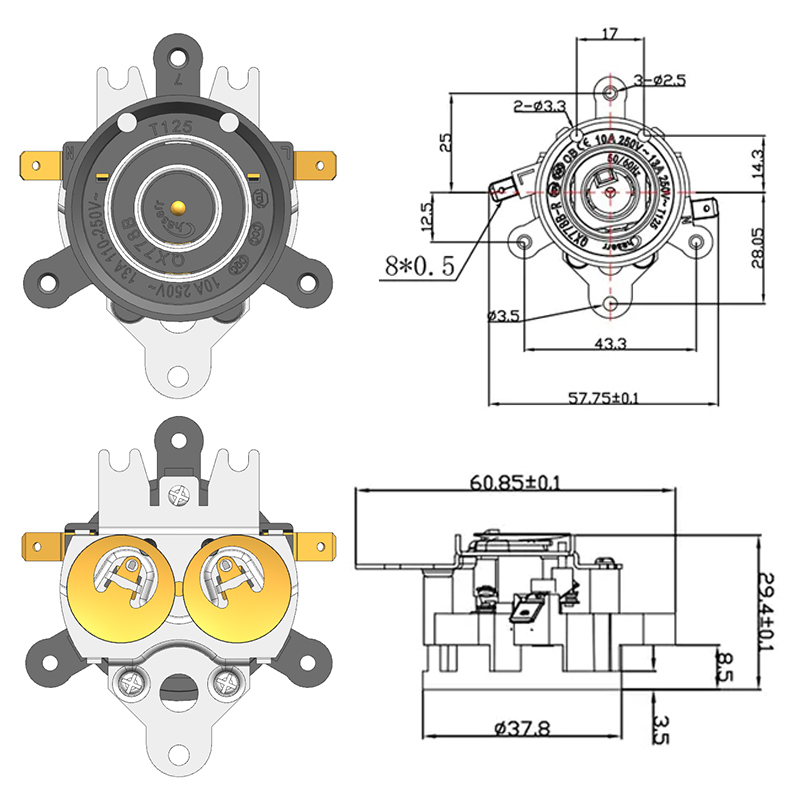
• Hard water contains high concentrations of minerals such as calcium and magnesium, which form scale deposits on the heating plate where the thermostat reads temperature changes.
• As scale builds up, it creates a barrier between the heating surface and the sensor, slowing down heat transfer and delaying temperature detection.
• This delay can cause the thermostat to react less quickly in identifying low-water conditions, slightly reducing the accuracy of dry-boil protection.
While the system remains functional, greater scale accumulation means response times may increase, especially during repeated daily usage. Regular descaling helps maintain suitable sensitivity.
How Does Mineral Buildup Influence Thermal Efficiency?
Heat transfer efficiency is a key factor in thermostat performance, and hard water can gradually reduce this efficiency.
• Mineral deposits act as an insulating layer, causing the heating plate to heat unevenly and more slowly.
• Uneven heating makes it harder for the thermostat to determine the real temperature at the metal surface, sometimes triggering premature or delayed shutoff.
• In some cases, heat can become concentrated in areas with less scale, causing the thermostat to misinterpret temperature spikes as potential dry-boil events.
Although these situations rarely result in system failure, they illustrate how thermal interference from mineral buildup can impact day-to-day precision.
Can Hard Water Shorten the Thermostat’s Lifespan?
Long-term exposure to hard water does not directly damage the thermostat’s internal components, but indirect effects can influence its service life.
• Excessive scale increases the temperature load on the heating plate, forcing the thermostat to activate protection more frequently, which adds mechanical stress to the switching mechanism.
• High-temperature hotspots caused by scale can accelerate wear on the thermostat’s contact surfaces.
• Prolonged overheating events may cause metal fatigue or weaken spring-loaded components responsible for triggering the protective mechanism.
These factors do not instantly reduce lifespan, but cumulatively, they can cause earlier performance decline compared to usage in soft-water environments.
Do Hard Water Conditions Increase Maintenance Requirements?
Regular maintenance becomes more important when kettles operate in hard water regions.
• Users must perform descaling more frequently to prevent excessive mineral buildup on the heating surface that the thermostat relies on.
• Some kettles incorporate removable or coated heating bases that resist scale; paired with the thermostat, these designs can significantly reduce maintenance frequency.
• If descaling is neglected, the kettle may exhibit symptoms such as longer boiling times, louder operation, or more frequent shutoff cycles—signs that the thermostat is compensating for reduced efficiency.
Proper descaling is essential not only for thermostat sensitivity but also for overall kettle health.
How Do Engineering Enhancements Address Hard Water Challenges?
Modern thermostats and kettle designs often incorporate optimizations to mitigate the effects of hard water.
• Many heating bases now use anti-scale coatings that limit mineral attachment, allowing the thermostat to maintain accurate readings over longer periods.
• Some kettles employ raised or recessed sensor areas designed to avoid heavy scale accumulation.
• Advanced thermostat modules may use dual-sensing elements to improve accuracy even when partial scaling is present.
These innovations do not eliminate the impact of hard water but significantly reduce its severity, improving both safety and longevity.
Is the Thermostat Still Reliable in Hard Water Regions?
Despite the challenges, the thermostat remains highly reliable when users maintain the kettle properly.
• Hard water mainly affects the external environment around the thermostat rather than its internal components.
• Regular cleaning and moderate descaling ensure the sensor receives accurate thermal feedback.
• Even in heavily scaled environments, modern thermostat mechanisms are designed to err on the side of safety, shutting down heating if uncertain conditions are detected.
Therefore, while hard water can reduce sensitivity and place additional stress on the thermostat, responsible maintenance and modern engineering allow the system to operate safely and effectively for many years.
Featured Products


-
No. 2892, Ningkang East Road, Tiancheng Industrial Zone, Yueqing City, Zhejiang Province
-
 Email: Una@chaserr.cc
 -
 Phone: +86-13075775533
- GET IN TOUCH

Electric Kettle Thermostat Coupler Manufacturer