English
  中文简体
中文简体  Español
Energy Use and Temperature Response in Modern Kettle Controls
What Makes Their Energy Behaviors Different?
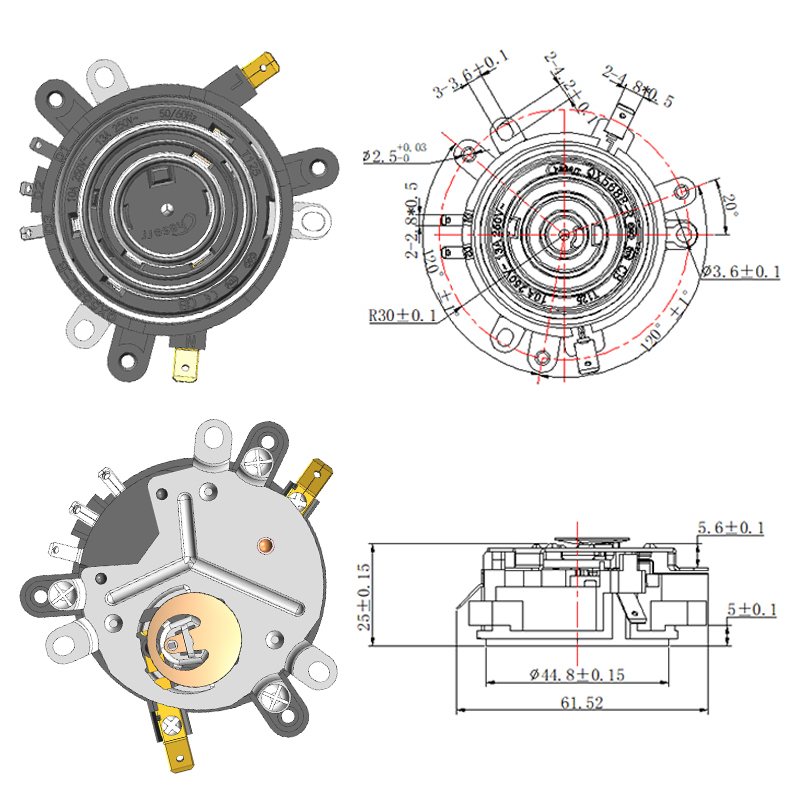
The Smart Kettle Thermostat Coupler introduces a more refined energy-management approach compared with traditional mechanical thermostats, largely due to its ability to detect temperature changes with higher precision and react with delay. Mechanical controls typically rely on bi-metal bending or physical expansion, which creates a noticeable lag before the circuit is opened or closed. This delay means the heating element often runs longer than necessary, wasting energy and causing temperature overshoot. In contrast, a digitally interpreted signal in a modern coupler enables faster recognition of rising heat and earlier cut-off, reducing unnecessary power consumption. Because of its tighter tolerances and smaller variance, the system can maintain temperature with shorter heating cycles, lowering cumulative energy use over repeated boiling or keep-warm operations. The result is a design that consistently avoids the wide swings seen in older thermostatic systems and supports improved efficiency during daily use.
How Do Their Temperature Response Speeds Compare?
Speed is a defining difference between these two types of temperature controls. Mechanical thermostats depend on thermal inertia; they respond only after enough heat physically deforms the sensing element. This means that even if the water is near its target temperature, the heater may continue running because the sensor takes time to “catch up.” The Smart Kettle Thermostat Coupler, on the other hand, collects temperature inputs through a more immediate detection mechanism and uses electronically optimized switching to engage or disengage power. The rapid signal transmission significantly shortens the time between temperature change and system response. This also contributes to a more stable temperature profile, because the heater cycles on and off with greater accuracy and less delay, allowing the kettle to reach boiling faster while also reducing unnecessary reheating.
Why Does Precision Influence Energy Efficiency?
Precision is a key factor in understanding efficiency benefits. A mechanical thermostat often has a broad tolerance range, which can cause irregular heating patterns. Over time, its components may wear down, increasing variance and further reducing accuracy. This can cause the kettle to cycle inefficiently, using more power to reach the same boiling point. In contrast, a modern coupler maintains a narrow accuracy band, ensuring that the heating element activates only when needed. Stable accuracy also improves long-term performance, as it reduces thermal shock and operational stress on internal components. By requiring fewer heating cycles to maintain the same temperature, the kettle consumes less total energy across many uses, especially when employing keep-warm functions common in smart appliances.
How Do These Differences Affect Actual User Experience?
From a user’s perspective, the contrast becomes clear in everyday convenience. A kettle equipped with a swift electronic coupler reaches boiling temperatures more predictably, avoids prolonged noise caused by unnecessary heating, and cools less between cycles. Mechanical systems frequently oscillate between too high and too low temperatures, causing inconsistent performance and more frequent reheating. Users may notice that their kettle reheats water even when it seems unnecessary, an inefficiency tied to the slower and less precise nature of mechanical sensing. With faster response and reduced delay, a modern control system produces a smoother temperature curve, reducing wait times and improving overall usability. The energy savings accumulate over time, especially in households that boil water multiple times per day or use temperature-hold modes.
Is the Modern Approach Always the Better Option?
While modern couplers provide clear improvements in energy consumption and response time, mechanical thermostats retain certain advantages, such as simpler construction and easier repairability. They can remain effective in low-cost appliances where precision and energy optimization are less critical. However, for consumers who prioritize efficiency, consistent temperature control, and rapid operation, the newer design offers more tangible benefits. The differences become especially noticeable in kettles that support multiple temperature settings or integrate with smart home systems, where finer control enhances functionality. Overall, the improved responsiveness and reduced energy waste of electronic control systems make them a preferred choice in contemporary applications, delivering both performance gains and more stable long-term operation.
Featured Products


-
No. 2892, Ningkang East Road, Tiancheng Industrial Zone, Yueqing City, Zhejiang Province
-
 Email: Una@chaserr.cc
 -
 Phone: +86-13075775533
- GET IN TOUCH

Electric Kettle Thermostat Coupler Manufacturer