English
  中文简体
中文简体  Español
Comparing Traditional and Digital Approaches in Temperature Control
Introduction to Two Distinct Control Technologies
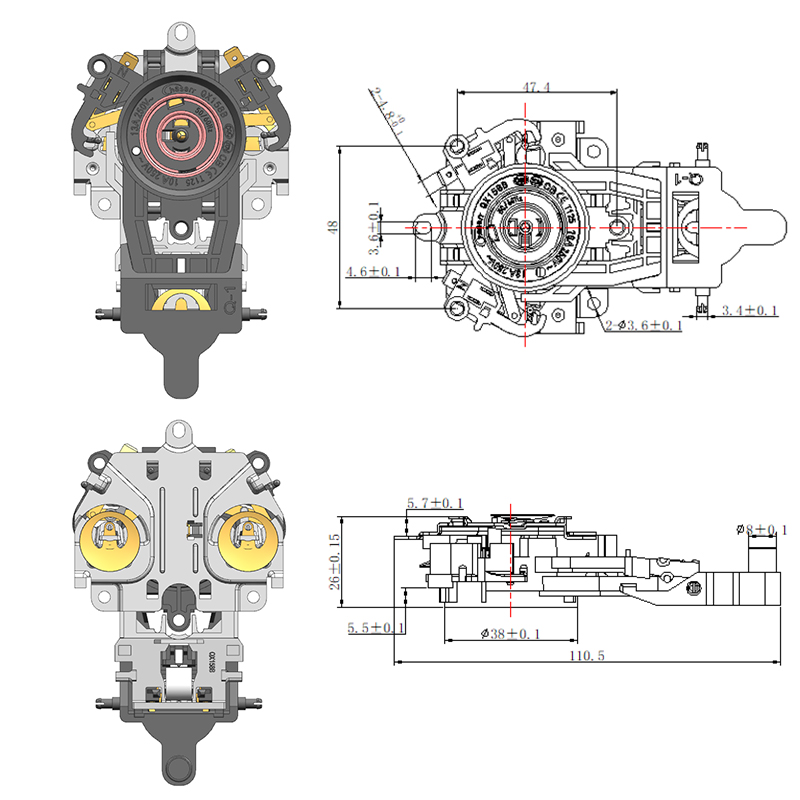
In many household appliances, industrial heaters, and temperature-sensitive systems, the choice between a Bimetal Iron Thermostat and a modern electronic controller often determines not only performance but also reliability and cost efficiency. A Bimetal Iron Thermostat uses the physical bending of bonded metals to open or close a circuit, while electronic temperature controllers rely on sensors, microchips, and programmed logic. Understanding how these two differ helps manufacturers, technicians, and users select the appropriate solution for their specific operating environment. Although both aim to maintain stable temperatures, their mechanisms, durability, accuracy, and long-term behavior vary significantly.
Mechanical Reliability and Durability Advantages
One of the strong benefits of a bimetal-based design is its robustness. Because it operates through simple mechanical deformation rather than electronic components, it is naturally resistant to power surges, electromagnetic interference, and minor voltage fluctuations. This makes it especially suitable for harsh environments, such as heating devices that undergo repeated thermal cycling. Mechanical thermostats can also continue functioning even as they experience gradual wear, offering predictable failure modes rather than sudden and total malfunction. By contrast, electronic controllers may fail abruptly if their integrated circuits become damaged or if moisture, dust, or corrosive vapors infiltrate the enclosure. In some low-maintenance applications, the mechanical option remains preferred precisely because it requires minimal attention over long operating periods.
Cost Efficiency and Ease of Integration
Another clear advantage of a Bimetal Iron Thermostat is its cost-effective structure. Without circuit boards, digital displays, or sensor modules, manufacturing costs stay low. This makes it easier for appliance builders to integrate basic thermal protection at scale without significantly raising the price of the end product. The simple wiring also reduces installation complexity; units require only a straightforward series connection, enabling rapid assembly and replacement. Electronic controllers, in comparison, involve more components—temperature sensors, microcontrollers, power supplies, and user interfaces—all of which increase production costs. Although their added precision may justify the expense in high-performance systems, they are less economically attractive for low-to-mid-end appliances where thermal regulation does not require fine resolution.
Accuracy, Response, and Control Limitations
Despite their advantages, mechanical thermostats have noticeable limitations in precision. Switching points are typically subject to wider tolerances, and hysteresis gaps can be relatively large. This means the device may allow temperature to drift more widely before reacting. Electronic temperature controllers, on the other hand, can achieve high accuracy and maintain extremely tight temperature bands due to digital sensing and programmable logic. They also offer faster response times and can incorporate alarms, multi-stage control, or adaptive algorithms. For processes that demand strict stability, such as lab equipment or certain industrial ovens, digital systems outperform mechanical devices by a significant margin. Mechanical thermostats simply cannot match such responsiveness because they depend on the physical bending rate of metals.
Flexibility, Features, and Control Functions
Electronic temperature controllers offer far greater functional flexibility. They can control multiple outputs, integrate with automation systems, record temperature history, adjust control curves, and allow users to manage settings through digital interfaces. In contrast, a simple bimetal-based switch performs only a basic on-off operation. It does not support programmable timing, predictive algorithms, or multi-sensor input. For applications that require customized or evolving control strategies, electronic systems easily accommodate modifications through software updates. For mechanical thermostats, such functional expansion is not feasible without redesigning the hardware.
Choosing the Appropriate Technology
The comparison shows that each technology has a clear role depending on the application. Mechanical thermostats excel in durability, simplicity, and low cost, making them ideal for devices where basic thermal cutoff or cycling is sufficient. Electronic controllers provide higher accuracy, additional features, and refined performance suitable for demanding environments. The decision ultimately depends on budget, environmental conditions, required precision, and system complexity. By evaluating these factors, designers and users can select the suitable approach to achieve safe, stable, and efficient temperature regulation.
Featured Products


-
No. 2892, Ningkang East Road, Tiancheng Industrial Zone, Yueqing City, Zhejiang Province
-
 Email: Una@chaserr.cc
 -
 Phone: +86-13075775533
- GET IN TOUCH

Electric Kettle Thermostat Coupler Manufacturer