English
  中文简体
中文简体  Español
How Kettle Steam Switch Ensures Automatic Boiling Shut-Off
A kettle that refuses to shut off — or one that cuts power halfway through heating — is not just an annoyance. For appliance engineers and OEM manufacturers, it means warranty claims, product recalls, and certification failures. The kind of damage that shows up quietly at first, then all at once. Sitting at the center of that whole safety chain is the Kettle Steam Switch: compact, mechanically driven, and carrying far more responsibility than its size suggests. It converts a thermal event into an electrical action, and when it works correctly, the user never has to think about it. When it does not, the consequences are hard to ignore.
The Core Job: Turning Steam Into an Electrical Signal
The steam switch does one thing, and it does it through physics rather than programming. When water reaches boiling point, the switch detects the resulting steam and uses that signal to cut power to the heating element. Not water temperature. Steam. That distinction is worth pausing on.
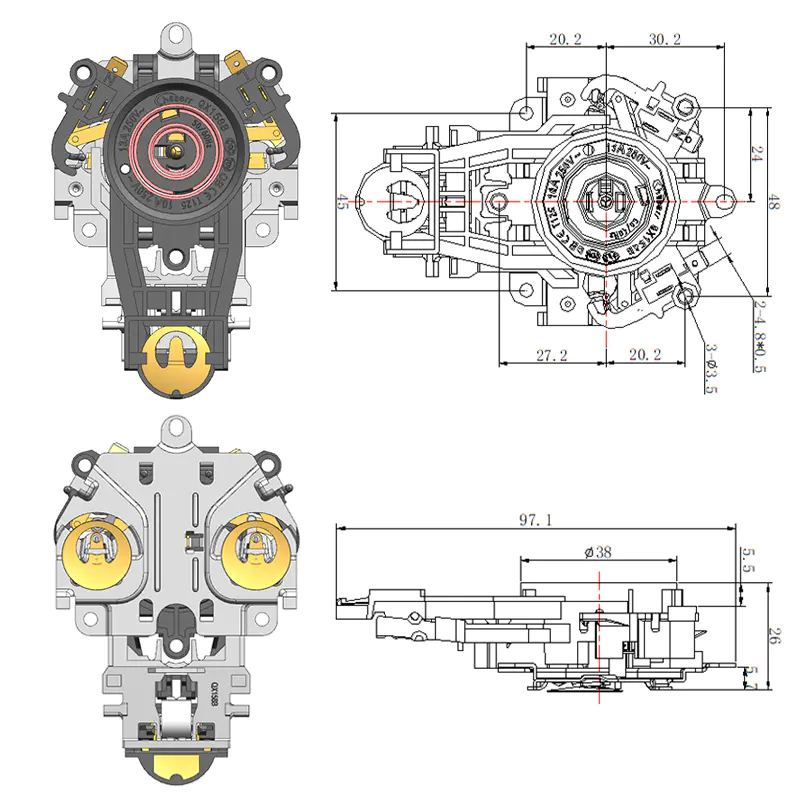
Steam rises through a channel built into the kettle body and travels toward the switch housing. The thermal energy it carries becomes the trigger. There is no microcontroller involved, no digital sensor polling a reading — just steam moving through a path, hitting a surface, and causing something mechanical to happen. Straightforward in concept. Demanding in execution.
What Is a Bimetallic Strip and Why Does It Matter?
The Mechanical Heart of the Switch
Two metals. Bonded together. That is the bimetallic strip in its simplest description. Each metal expands at a different rate when heated, and because they cannot move independently, the strip bends — curves toward the side that expands less. Predictably. Repeatedly. At a temperature determined by the materials and geometry chosen during design.
When steam heats the strip enough, it bends far enough to push against a lever inside the switch housing. The lever shifts. Contacts separate. Power cuts off. It sounds almost too simple, but the reliability of this mechanism across millions of cycles is what makes it the standard approach in electric kettle design. Once the steam dissipates and the strip cools, it returns to its resting shape — ready for the next boil.
Why Snap-Action Design Improves Reliability
Here is a practical problem: a strip that bends slowly produces a slow contact separation. Slow separation means arcing — those brief electrical sparks that jump between contacts as they drift apart. Arcing is not harmless. It deposits carbon, erodes contact surfaces, and over time makes clean switching increasingly unreliable.
Snap-action design addresses this by adding a spring element that amplifies the bimetallic movement into a sudden, clean break. The contacts do not drift apart — they snap. One moment closed, the next open. That abruptness is what protects the contacts from arc damage and keeps the switch performing consistently across a long service life.
The Full Action Sequence: From Boiling Water to Power Cut
Seeing the whole mechanism laid out step by step makes failure points easier to identify:
- Water inside the kettle reaches boiling point
- Steam rises and enters the steam channel built into the kettle body
- Steam reaches the switch chamber and heats the bimetallic strip
- The strip reaches its activation threshold and snaps
- The mechanical lever is pushed by the strip's movement
- Electrical contacts are forced apart
- The circuit opens; power to the heating element stops
- Steam production drops as heating ceases
- The bimetallic strip cools and returns to its resting shape
- The switch resets, ready for the next cycle
Every step depends on the one before it. Block the steam channel and the strip never heats. Fatigue the strip and it may not snap at the right point. Wear the contacts down and they may not separate cleanly even when everything else works. The chain is only as solid as its weakest link.
What Happens When the Switch Fails?
Common Failure Modes and Their Causes
Failure rarely looks the same twice. Some switches stop cutting off altogether. Others trip too early, leaving water barely warm. A few develop intermittent behavior that is harder to diagnose than an outright failure.
| Failure Mode | Likely Cause | Consequence |
|---|---|---|
| No shut-off at boil | Blocked steam channel or worn bimetal | Continued boiling, dry-boil risk |
| Premature shut-off | Bimetal threshold too sensitive | Kettle cuts out before full boil |
| Switch does not reset | Bimetal fatigue or damaged spring | Kettle cannot restart without manual intervention |
| Intermittent shut-off | Loose contact assembly or partial bimetal wear | Unpredictable behavior, user safety concern |
| Contact welding | Arcing from slow contact separation | Switch locked closed, no auto shut-off |
The pattern across many of these is that they worsen with use. A switch that performs adequately early in its life may degrade noticeably after heavy cycling. For OEM manufacturers, that degradation curve maps directly onto warranty return timelines and after-sales cost.
Is the Steam Channel Design Part of the Switch's Performance?
Yes — the Channel and the Switch Work as a System
It is tempting to evaluate the steam switch on its own. In practice, that evaluation is incomplete. The channel that carries steam from the water surface to the switch housing is equally important — maybe more so in poorly integrated designs.
A channel that is too long, too narrow, or leaking at its joints loses steam energy along the way. By the time what remains reaches the bimetallic strip, it may not carry enough heat to trigger activation at the right moment. The switch activates late. Or not at all.
Factors that shape how well the channel delivers steam:
- Channel length and diameter — a shorter, wider path carries steam with less energy loss
- Seal integrity — any gap in the channel bleeds pressure before it reaches the switch
- Channel positioning — where the channel opening sits relative to the boiling zone affects capture speed
- Condensation buildup — water collecting inside the channel can slow or partially block steam flow
OEM designers who specify the switch independently of the channel geometry often run into integration problems during prototyping. The two elements need to be matched, not selected in parallel and assembled in hope.
Thermal Cutoff vs. Steam Switch: Are They the Same?
Two Different Safety Layers in One Kettle
No — and treating them as interchangeable is a specification error that shows up downstream. The steam switch handles routine operation: it detects boiling and cuts power under normal conditions. The thermal cutoff (TCO) is something else entirely. It is a backup device that activates only when the kettle reaches a temperature it should never reach under normal use — the kind of temperature that occurs when the element runs dry.
A typical electric kettle carries both:
- Steam switch — triggered by steam at boiling point, mechanical, reusable
- Thermal cutoff — triggered by abnormal body heat, often single-use, fuse-style protection
The TCO is not there to replace the steam switch. It catches the failure scenario the steam switch was supposed to prevent. If the steam switch misses a shut-off and the water boils away entirely, the TCO steps in. Without it, a missed steam switch activation has nowhere to stop. Both components belong in the specification from day one — not as alternatives but as layers.
How Does Switch Sensitivity Affect User Experience?
The Balance Between Early Cut-Off and Proper Boiling
Sensitivity comes down to where the bimetallic strip is calibrated to snap. Set it too low and the switch trips before the water reaches a rolling boil — users get lukewarm results and wonder if the kettle is broken. Set it too high and the water boils a few seconds longer than needed before power cuts, which is rarely a problem but can affect energy use in high-volume applications.
For standard residential kettles, manufacturers have settled on calibration ranges that work well under typical conditions. The challenge arises with products that operate outside those norms. Travel kettles used at altitude encounter lower boiling points. Specialty beverage kettles may need to stop at temperatures well below full boiling. Commercial units with high daily cycle counts may need tighter tolerances to avoid drift over time.
This is the gap between catalog parts and engineered solutions. A supplier who can discuss calibration options — and adjust them for a specific product brief — is a different kind of partner than one who ships from stock and moves on.
Mechanical Durability: What Determines a Switch's Service Life?
Cycle Count, Contact Material, and Housing Integrity
Daily use puts the switch through a punishing routine. Heat, cool, snap, reset. Repeated across years of use. The materials chosen for each element of the assembly determine how long that routine stays reliable.
- Contact material — silver alloy contacts hold up against oxidation and arc erosion better than cheaper alternatives
- Bimetallic strip fatigue resistance — the strip must snap at a consistent threshold after extensive heat-cool cycling, not drift gradually toward early or late activation
- Housing material — sustained steam exposure tests the switch body; warping or cracking disrupts the alignment of internal components
- Spring preload stability — the snap-action spring must hold its tension across the product's working life
What makes this harder than it looks is that these factors interact. Strong contact material does not help if the housing warps and knocks the contacts out of alignment. A stable bimetallic strip means little if the spring loses tension and the snap action becomes sluggish. Switch quality assessment has to take in the whole assembly.
What Should OEM Buyers Evaluate When Sourcing Steam Switches?
A Practical Checklist for Component Procurement
Price per unit is the starting point, not the endpoint. The real evaluation goes deeper:
- Does the supplier provide cycle life test data for the specific switch model?
- What activation threshold range does the bimetallic strip cover, and can it be adjusted for a specific product application?
- What contact materials are used, and how do they hold up under repeated arcing?
- Is the housing rated for sustained steam and heat over the product's intended service life?
- Does the switch design physically accommodate the steam channel geometry of the target kettle body?
- What certifications does the switch carry, and do they cover the markets where the finished product will be sold?
- Can the supplier provide engineering support during design-in for new kettle platforms?
A supplier who answers those questions with documentation rather than verbal assurance is worth more than a lower-priced one who cannot. The difference tends to show up at certification stage or in the field — neither of which is a convenient time to discover a mismatch.
Choosing the Right Component Partner
There is a version of this procurement decision that looks simple: find a switch, check the price, place the order. The version that holds up in practice is more involved. Switch performance shapes product safety, field reliability, and certification outcomes — none of which are recoverable cheaply after the fact. Wenzhou Qianxun Electrical Technology Co., Ltd. develops thermal control components for the appliance industry, with a focus on switch sensitivity calibration, contact durability, and housing stability under sustained thermal cycling. Their range covers steam switches and thermal cutoff components built for OEM kettle and small appliance platforms. If your team is working through switch options for a new kettle design or trying to address reliability issues on an existing line, reaching out to discuss specifications and test documentation is a practical way to start that conversation on solid ground.
Featured Products


-
No. 2892, Ningkang East Road, Tiancheng Industrial Zone, Yueqing City, Zhejiang Province
-
 Email: Una@chaserr.cc
 -
 Phone: +86-13075775533
- GET IN TOUCH

Electric Kettle Thermostat Coupler Manufacturer