English
 中文简体
 Español

What Materials are Commonly Used in Electric Kettle Thermostat Couplers
Electric kettle thermostat couplers are built from more than one material family. Conductive metals form the current path. Insulating plastics separate terminals and form the housing. Structural metals appear where stiffness or retention is needed. Each group answers a different requirement inside the same small assembly.
Material choice affects electrical behaviour, heat tolerance and how the part survives assembly and use. Composition and construction therefore sit together when a kettle thermostat coupler is specified for heating-system duty.
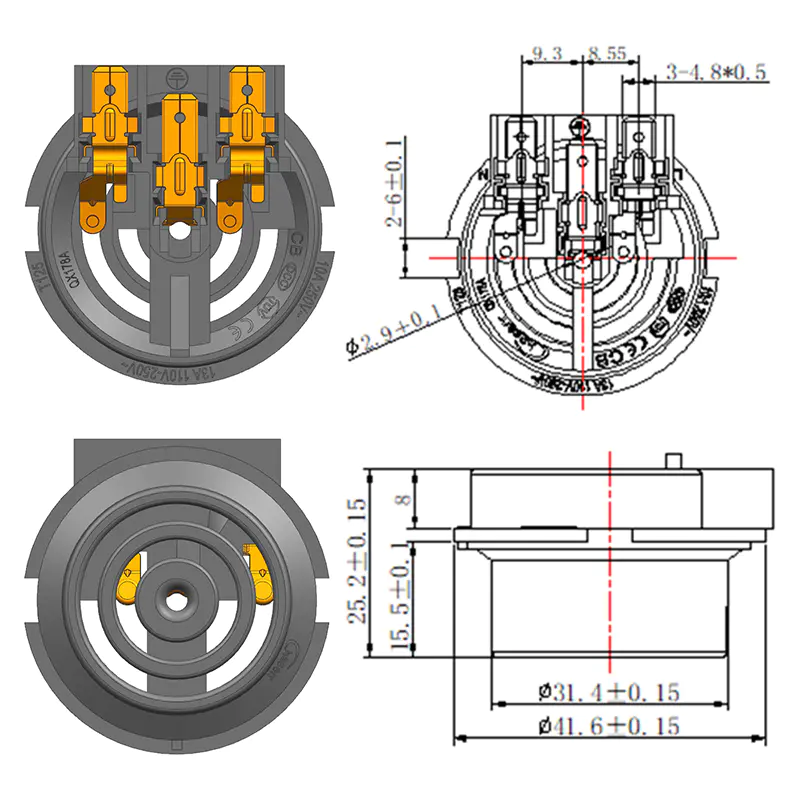
Copper and Copper Alloys in the Contact Path
Copper and copper-based alloys are widely used for terminals and contact parts because they conduct well and can be formed into springs, blades and pins. Those contacts complete the electrical path between the thermostat side and the mating circuit.
Contact geometry, surface condition and alloy selection all influence how stable the joint stays under the appliance's intended load. Conductive metal parts are central to the construction of an Electric Kettle Thermostat Coupler; without a sound contact set, the interface cannot do its job.
Stainless and Other Metals for Structure
Where the coupler needs mechanical strength, brackets, clips or stiffeners, stainless steel or other suitable metals may be used. Those pieces are chosen for shape retention and resistance to the local environment rather than for carrying current.
Electrical contact metals and structural metals should not be confused. Each should match its role—conductivity on the one hand, support and durability on the other—so that the assembly meets both circuit and handling needs in the kettle.
Heat-Resistant Plastics for Housing and Insulation
Engineering plastics with appropriate heat resistance form the insulating body that holds terminals apart and gives the coupler its outer shape. The housing must keep creepage and clearance as designed and must not soften or creep in the warm zone near the heating system.
Dimensional stability after moulding and after heat exposure matters for fit to the thermostat and to the appliance cavity. Insulation performance and resistance to deformation under temperature are primary reasons those grades are selected for kettle couplers.
Insulation, Spacing and Appliance Requirements
Conductive and insulating materials work as a pair. Plastics and air gaps prevent terminals from touching where they must not; metals carry current only where intended. Dielectric behaviour, heat resistance and mechanical integrity of the insulator support the electrical arrangement required by the appliance standard and the design file.
Material selection should follow those electrical and safety requirements rather than appearance alone. A coupler that combines suitable conductive and insulating materials is easier to integrate into a controlled heating assembly. Links to the Electric Kettle Thermostat and related parts depend on that combination remaining stable.
Plating and Surface Condition on Terminals
Contact surfaces often receive tin, nickel, silver or other finishes suited to the base metal and the application. Finishes can improve resistance to oxidation and stabilise contact behaviour over storage and service life.
Choice of plating depends on the substrate, the expected environment and whether the joint is permanent or separable. Surface condition is part of functional design, not only cosmetics, for kettle thermostat connectors.
Materials That Fit Process as Well as Performance
Stamping, forming, moulding and terminal insertion each favour certain materials. An alloy that conducts well must still form cleanly; a plastic that insulates well must fill the tool and hold tolerance. Matching material to process supports consistent dimensions and fewer assembly defects.
Application-specific combinations—contact alloy, housing grade, optional structural metal and plating—give the Electric Kettle Thermostat Coupler its balance of conductivity, insulation and buildability.
Selecting Combinations Rather Than a Single Material
No single material covers conduction, insulation, structure and surface protection at once. Buyers and designers evaluate compatibility between metals and plastics, thermal exposure, electrical duty and how the kettle is put together.
An Electric Kettle Thermostat Coupler is specified as a set of material functions that together meet assembly and operating needs. Appropriate combinations support connector function, structural stability and integration into the appliance. A Kettle Connector discussion should always return to those combined roles.
Water Heater Coupler and Heater Coupler sourcing in related products follows the same logic: conductive path, insulating body, suitable finishes and process-capable grades chosen together rather than in isolation.
Material Group and Role in the Coupler
| Material Group | Typical Role | Selection Focus |
|---|---|---|
| Copper and Copper Alloys | Terminals and electrical contacts | Conductivity, formability, contact geometry |
| Stainless and Structural Metals | Clips, supports, stiff features | Strength, stability, environment |
| Heat-Resistant Plastics | Housing and insulation | Thermal stability, dielectric spacing, mouldability |
| Contact Platings | Surface condition | Oxidation behaviour, substrate compatibility |
| Combined System | Full coupler | Fit to thermostat, heat zone and assembly method |
Material Sets That Support Reliable Coupler Function
Electric kettle thermostat couplers rely on conductive metals, insulating plastics, optional structural metals and protective finishes working as one construction. Wenzhou Qianxun Electrical Technology Co., Ltd. supplies thermostat couplers and related connection components for electric kettle and heating appliance production. Review of electrical duty, thermal environment and assembly process against material specifications supports selection of coupler constructions suited to stable appliance integration.
Featured Products


-
No. 2892, Ningkang East Road, Tiancheng Industrial Zone, Yueqing City, Zhejiang Province
-
 Email: Una@chaserr.cc
-
 Phone: +86-13075775533
- GET IN TOUCH

Electric Kettle Thermostat Coupler Manufacturer